

The Time
Christians normally meet together on Sunday mornings for church gatherings. This pattern goes back to the earliest times when Christians would gather to remember and celebrate the resurrection of Jesus on the first day of the Jewish week. Some Christian groups, for other reasons, choose a different weekly time for church meetings.

The Place
The word “church” properly refers to the people rather than the building, but it is commonly used to refer to the place we come together in. Some Christian communities have their own building, some use another congregation’s building, while others rent a public venue such as a school or community hall. There are different Christian traditions about the significance of the physical building and how exactly it can be used, although the Bible itself offers little on this matter—churches in the New Testament typically met in large homes.
The People
The range of people you might meet in any given church can be quite diverse, both between different churches and even within individual churches. You will not find a group of flawless people or perfect commitments, but this is not what the Bible ever leads us to expect. You will find people at differing stages of life, from different backgrounds, with different opinions, at different stages of faith and Christian commitment. What unites them is a common commitment to following Christ and a story that has brought them to that particular church community.
Singing
Church gatherings normally include several songs that are sung together by the congregation. These songs are usually led by one or more music leaders, and the words to the songs are provided. The songs may be modern, or traditional, or a mix of both. Christians sing as an expression and reminder of their faith and to collectively voice their devotion to God. The songs in any given church gathering should convey a range of expressions of multiple facets of Christian belief.
Further Reading: Article by Crossway, “Why Do We Sing in Chruch? Five Reasons.”
The Sermon/Message
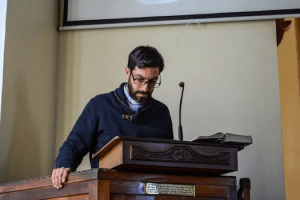
A normal church gathering will include a spoken message from a speaker or preacher. This will usually be based on a single paragraph from the Bible or a series of short texts on a topic. Sermons tend to explain the meaning of biblical passages and give instruction and encouragement in Christian belief and Christian living. Most church services will have a message that is anywhere between 20–40 minutes. Q&A is not a normal part of a sermon, simply out of tradition more than any avoidance of criticism, although this could be a helpful addition to the sermon!
Prayer Together
Church gatherings will often include a time when someone will pray on behalf of the church, giving thanks to God for good things that have happened and asking his intervention in difficulties affecting the church, individuals, or the nation. Sometimes more of the congregation will be involved in praying.
Communion
The is the practice of taking and eating bread and wine (or grape juice) which commemorates breaking of Jesus’ body and the shedding of his blood at his crucifixion. Also known as “The Lord’s Supper” or the “Eucharist.” Sometimes a whole loaf of bread is symbolically broken, or the bread may be pre-cut, or take the form of thin wafers. The wine or juice is normally in tiny cups for individuals, although some churches retain the much older practice of having everyone sip from one full-sized cup. Some churches do this every week, while others might only once per month or even less often. During this time, bread and wine are either passed around the congregation on a tray for Christians to take for themselves, or they move to the front of the space to take it from a table, or it is given to them by a church official. During communion, Christians remember Jesus’ sacrifice on the cross, recommit ourselves to him, and look forward to his return.
Baptisms
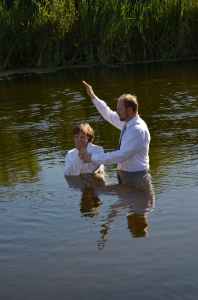
Sometimes a baptism ceremony will happen during or after a church service. This is where a new Christian is ceremonially pushed under water in a baptismal pool and then (immediately) brought back up. This movement symbolises Jesus’ death and burial and subsequent resurrection, and by being baptised the baptised identifies themself with Jesus and that their old life has been buried, and that they have entered a new form of life that is committed to Jesus. This is a ceremony of formal initiation into the Christian faith, and the baptised person is expected to make a verbal confession of their repentance from an old way of life and a commitment to the Christian faith and to following Jesus. Many churches practice the older tradition of baptising infants, although the appropriateness of this is debated among Christians.
“Denominations”
There are many kinds (“denominations”) of church groupings, each with their own histories, emphases, and ways of doing things. In New Zealand, many common denominations include the Anglicans, Presbyterians, Baptists, the Open Brethren or Community Churches, Catholics, Methodists, and varieties of Pentecostal denominations and independent churches that are not part of a larger denomination. Despite the differences, most Christian church denominations have much in common and have good relationships between local churches.
Financial Giving
Like all organizations, churches need finances to operate, to pay staff, building maintenance, and other operational expenses. Much of this comes from regular financial contributions from members of the church. Some churches emphasise the concept of the “tithe” (i.e. “tenth” of their income), although most churches do not. Members simply give what they feel comfortable with, as part of their commitment to God. Financial contributions can be collected physically during the church service, or through online banking. Income and expenditure are generally not kept secret from members.
Leadership
Churches are run by various kinds of leaders. These can be paid full- or part-time, or volunteer, and take responsibility for the oversight of the church, pastoral care and teaching, and for specific activities of the church community or the church service. They are expected to have a stable faith and mature Christian character. A range of titles may be given to church leaders, depending on the kind of church and the specific roles and responsibilities entrusted to them.
Creeds/Confessions
Some churches will recite traditional Christian “creeds” on a weekly or occasional basis. Some of these creeds outline core doctrines of the Christian faith that have been held by the churches since ancient times, such as what is called the “Apostle’s Creed” or the “Nicene Creed.” Other “confessions of faith” might be more recent and comprehensive in clarifying Christian beliefs. Some might be a few hundred years old (such as the Westminster Confession or the 1689 Baptist Confession) and bind together whole denominations, while others are quite short and might serve only a single church. Longer creeds will not be recited but used as a reference to anchor the beliefs of the church. Reciting them acknowledges and reinforces our commitment to the historic Christian faith.
 Take Another Look