
Did you know that Santa Claus is more popular than Jesus around Christmas time? And that Jesus is more associated with Easter than he is with Christmas? According to a search on Google trends, searches in New Zealand on Santa spike in popularity every December, while searches on Jesus only get a very small bump but increase around Easter. [See here: Santa, Jesus – Explore – Google Trends]

So, at this time of year Santa is on people’s minds more than Jesus is, despite the fact that the holiday is a commemoration of the birth of Jesus.
Nevertheless, Jesus is still a point of interest, and questions and criticisms about the events and significance of his birth still arise.
This post is a compilation of online resources that discuss Christian beliefs and practices surrounding Christmas. Some rebut the idea that Dec 25th was originally a pagan holiday (although I’m not sure it would matter if it was). Some explore the differences between the birth stories in different Gospel accounts. Others look at the idea of Jesus’ “virgin birth” and the notion that his birth is just a copycat of older pagan myths.
For an initial and easy read, see this short post by musician and writer Alisa Childers, who writes five short pieces on the questions:
- Was Jesus born on December 25th, AD 1?
- Is Christmas a pagan holiday?
- “We three kings of Orient are” (considers the three wise men)
- Is the story of Jesus’ virgin birth just a retelling of ancient mythology?
- Was Jesus born in a stable?
You can read her short answers here: 5 Apologetics Questions Every Christian Should Learn How to Answer: Christmas Edition

For a slightly beefier overview of the issues involved in some of the most popular critiques, see this article from the Bible Archaeology Report website: Myth-busting the Supposed Pagan Roots of Christmas. It covers:
- Christmas Symbols and Traditions
- The Date of Christmas
- The Virgin Birth of Other gods
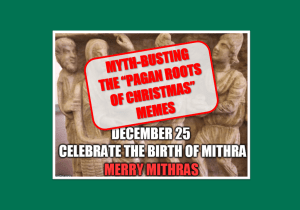
For a video version of that essay, watch it on YouTube below:
Enjoy the reading or listening. Feel free to get in touch if you wish to discuss anything you’ve read here (contact page is HERE).
“December 25th was a pagan holiday, not Jesus’ birthday”
This is the claim Christians took over an ancient pagan Roman holiday. Interestingly, this doesn’t address the fact that Christians in the Eastern world (i.e. historic churches from Eastern Europe and the eastern Mediterranean) have a long-standing tradition of celebrating Jesus’ birth on January 6th. December 25th is the date that was settled on by Christians from western Europe.
- This article by a Greek historian-archaeologist explores the claim that the Christian celebration of Jesus’ birth replaced pagan celebrations. He concludes that “the historical evidence suggests that Christmas did not originate as a pagan rip-off, as commonly believed” and that “while there may be some synchronistic connections, the date of December 25 for Christ’s birth likely has deeper theological roots.” Debunking the Myth of Christmas’s Pagan Roots: The True Origins of Christmas
- Another article from the Stand to Reason website offers a similar discussion, looking at the evidence for when Christians started celebrating Jesus’ birth on December 25, and at where the idea that Christians adopted a pagan holiday date for this. A Very Pagan Christmas?
- This slightly longer article by a Yale University professor covers similar ground, and concludes: “In the end we are left with a question: How did December 25 become Christmas? We cannot be entirely sure. Elements of the festival that developed from the fourth century until modern times may well derive from pagan traditions. Yet the actual date might really derive more from Judaism—from Jesus’ death at Passover, and from the rabbinic notion that great things might be expected, again and again, at the same time of the year—than from paganism.” How December 25 Became Christmas – Biblical Archaeology Society
“The birth stories of Jesus contradict each other”
Stories about Jesus’ birth (the “Nativity” stories”) are contained within the Gospels of Matthew and Luke. The stories differ at many points. For example, the Wise Men are only mentioned in Matthew, while the shepherds are only mentioned in Luke. Sometimes it is argued that they contradict each other, thereby undermining the realness of Jesus’ origins and suggesting the stories are instead mythologies. Against this, biblical scholars have pointed out that while the stories differ, they do not do so inconsistently and they have plenty in common. Furthermore, the two authors of each Gospel no doubt made their own editorial choices for what to include in their own presentation of the birth of Jesus. Additionally, the differences may reflect the sources that they had access to: Matthew seems to reflect the story from Joseph’s point of view, while Luke is much more centered around Mary’s experiences. That would make a difference too.
- This article from the Tyndale House research centre in Cambridge, UK, examines two purported difficulties. One is how the travel events after Jesus birth fit together, the other are the two different genealogies of Jesus. Why are Jesus’s birth stories different? – Tyndale House
- This article from Christianity.com explores the different goals in writing shaped (in part) the birth narratives in Matthew and Luke. Do the Narratives of Jesus’ Birth Contradict Each Other? | Christianity.com
- For something longer and more technical, read “Detaching the Census: An Alternative Reading of Luke 2:1–7” by David J. Armitage. This tackles the challenge raised by the fact that an empire-wide census seems not to have occurred according to other ancient history sources. This is an academic article that has been published with an open-access for online reading. It presumes familiarity with interpretation of the details of the Bible text in the original Greek language that it was written in, but the argument can still be followed without understanding the method. Detaching the Census: An Alternative Reading of Luke 2:1-7 | Published in Tyndale Bulletin
- For something easier, here is a short video that answers the challenge of where Mary, Joseph, and baby Jesus’s escape to Egypt fits in with other events. Bible Scholar Think THIS is a Contradiction | Red Pen Logic
“The virgin birth of Jesus by his mother Mary is not believable”
The claim that Jesus’ conception was miraculous rather than ordinary has been scoffed at by critics of Christianity since ancient times. Two of the Gospels report that Jesus’ mother was engaged but not married (and had not had sexual intercourse), and that Mary’s pregnancy was initiated by the power of God’s Spirit (Matt 1:18; Luke 1:26–38).
Some critics misunderstand this by thinking that God had sex with Mary, while others believe that Mary must have been lying about a rape or pre-marital sex with her fiancé Joseph. Another proposal is that Christians made the story up as a way of explaining how Jesus was a supernatural figure—much in the same way that other religions or myths explained the origin of their gods or revered leaders.
- This essay from The Gospel Coalition gives an overview of the virgin birth: the biblical accounts, adherents in early Christian history, and theological implications. The Virgin Birth of Jesus Christ – The Gospel Coalition
- This essay from Patheos looks at many of the supposed similarities between Jesus on the one hand, and ancient deities Horus and Mithras on the other. The author shows that many of the claimed similarities don’t even exist, and others were made by worshipers of Mithras long after the advent of Jesus. The Shocking Truth About Jesus, Horus And Mithras | Keith Giles
- Another essay addressing the comparison with ancient mythologies comes from CrossExamined. It highlights the lack of ancient stories about some of these deities as well as how different they are to Jesus’ story. This essay is also helpful in that it points out how the virgin birth of Christ would have been a theological liability in the context of early Christianity, thus making it less likely to be made up, as well as the fact that early Christianity didn’t emphasise it, which would be strange if they had thought it was important enough to make up. Was the Virgin Birth Story Made Up? – CrossExamined
- For those of you who prefer watching video, here is a one-hour interview of Rev. Dr. David Instone-Brewer from Tyndale House in Cambridge, UK, discussing the virgin birth of Christ. Yes, Mary Really Was A Virgin (Christmas Apologetics), with David Instone-Brewer
- And for those of you who are like me and cannot bear to sit and watch a video of people talking to each other, here is a Podcast you can listen to while you are on the go with other tasks. It is by Dr Amy Orr-Ewing and runs for 27minutes. #79 Amy Orr-Ewing: Is there an…–Unapologetic | Premier Unbelievable? – Apple Podcasts
“The idea of God becoming a human being in the form of baby Jesus is not believable”
Christian faith emphasizes that in Jesus, God became a human being. This is known as the doctrine of the “incarnation”—a Latin word meaning “in-flesh-ment.” Some religions find this very difficult to swallow (and some non-religious people), and that is understandable. The following are some helpful resources exploring what the incarnation is and what it’s all about.
- For an essay overview of the incarnation, here is a copy of J. I. Packer’s 4-page chapter from his book Concise Theology. Incarnation by J.I. Packer
- Another theological explanation of the incarnation, read the following by theology professor Stephen Wellum. 10 Things You Should Know about the Incarnation | Crossway
- For a short post that is aimed more at preachers, read this by UK vicar Glen Scrivner. He points out what preachers often talk about when speaking on the incarnation, and suggests three better ways to bring out its importance. Glory to God in the Lowest
- This essay explores some of the practical-spiritual implications of the incarnation by Bethany Jenkins. The Shocking Implications of Incarnation
- And for the listeners, here is a sermon by pastor-author Alistair Begg, where he presents the incarnation as the very heart of the Christian faith, addresses common objections to the truth about Christ and presents the evidence that He was God made flesh. The Incarnation – Archive – Truth For Life
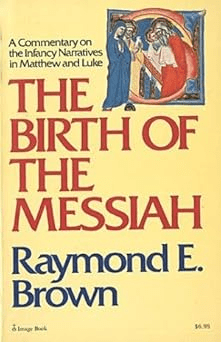
For a much longer read, there is Raymond Brown’s book The Birth of the Messiah: A Commentary on the Infancy Narratives in Matthew and Luke (1977). This is a thoughtful and thorough account of the texts describing the birth of Jesus. This book is available to read online with a free and simple account at Archive.org. A newer edition (1999) does exist with several additional chapters, but you will have to buy or borrow a physical copy of that one!
“Take Another Look” is a West Auckland-based ministry that aims to commend Jesus to people’s hearts and minds, and promote the way of life that the good news of Jesus invites us into. If you would like to discover the widely-held beliefs and practices and aspirations for good-character among Christians, please visit and explore www.TakeAnotherLook.nz. Or, if you have questions you would like discussed, please get in touch through the contact page.
Explore






 Take Another Look
Leave a comment