
This post is a compilation of online resources that discuss the resurrection of Jesus. Some show why the resurrection is the best reading of the evidence, while others discuss its theological significance or discuss the differences between the four Gospel accounts.
It is worth remembering that Jesus was not claimed to be an ordinary human being. He was not deemed to be an “ordinary-but-remarkable” human leader who died before his time. Instead, he was a long-promised figure with a mysterious identity that aligned him uniquely with God. The disciples struggled to understand this and the implications of this were teased out more fully by later Christian thinkers. The resurrection of Jesus, then, existed as part of a bigger—albeit puzzling—context.
Enjoy the reading, feel free to get in touch if you wish to discuss anything these raise (contact page is HERE).
Is it unreasonable to believe that Jesus rose from the dead? “Four Points of Evidence for the Resurrection” displays the case from a historical point of view. It is made in four stages:
- The indisputable fact of the execution by crucifixion of Jesus.
- The otherwise unexplained empty tomb of Jesus.
- The adamant persuasion of the early Christians that Jesus had been resurrected.
- The abrupt conversion of Paul—the violent persecutor of Christians who became an ardent missionary for Christianity.
https://www.crossway.org/articles/4-points-of-evidence-for-the-resurrection/

Other Theories of the Resurrection. If Jesus didn’t and couldn’t have risen from the dead, what else might explain the early Christian claims of his resurrection? Two popular theories that have been put forward are that he survived his crucifixion, or that the distraught disciples merely imagined that a resurrected Jesus appeared to them.
The article “What is the Significance of the Resurrection of Jesus” explains the shortcomings of these theories.
https://www.compellingtruth.org/resurrection-of-Jesus.html
What about the differences between the four Gospel accounts? “Do the gospel resurrection accounts contradict each other?” Lists differences between the four Gospels regarding the resurrection, and offers a reconstruction that draws together all the events and appearances of the resurrection. In discussing the differences, the author points out that:
- A partial account is not a false account.
- A divergent account is not a false account.
- A uniform story between the four accounts would face the accusation that they were working together to present a made-up event. This raises the question: what version of the four accounts would be deemed acceptable to critics who dislike Christianity and who cannot accept miraculous events?
It concludes that “most importantly, [the four Gospels] strongly agree on the one key fact that has universal life impact: Christ is risen from the dead!”
https://www.compellingtruth.org/resurrection-accounts.html

A longer article on the differences summarises the work of several scholars on the topic. “Do the Resurrection Accounts in the Four Gospels Contradict Each Other?” gives discussion on the topic, organised around several questions:
- What differences do we see in the resurrection accounts?
- Why might the resurrection accounts be written so differently?
- Why is it important that the resurrection accounts are eyewitness accounts?
- Do the differences mean the resurrection accounts contradict each other?
Why is the BODILY resurrection of Jesus important? It may surprise readers to know that for people in the Hellenistic-Greek culture of the first-century world in which Christianity emerged, while the idea of life after death was unremarkable, the idea of physical bodies being returned to life was deemed ridiculous. The prevailing culture of most of the Greco-Roman world could not accept physical resurrection because they devalued physical existence, and so early Christian writers had to meet that challenge when preaching that Jesus had risen from the dead.
“Why is the reality of the bodily resurrection of Jesus so central to the Christian faith?” takes a series to texts from the NT to present seven reasons why the physical resurrection of Jesus is so important.
https://www.compellingtruth.org/bodily-resurrection.html

The truth of Christianity uniquely stands or falls on Christ’s resurrection. “Five Strands of Evidence for Jesus Christ’s Resurrection” explains how the Gospel writers ‘not only report the resurrection as a factual event but also provide a theological context for and explanation of its overall significance to God’s historical redemptive plan’. The strands are:
- The Empty Tomb.
“One of the most fully substantiated facts surrounding Jesus’ resurrection is the empty tomb. Most New Testament scholars, even some liberal scholars, agree that solid historical fact stands behind the gospel claim that witnesses found Jesus’ tomb empty on that first Easter morning. Far from being a myth or legend, the report of the empty tomb has a very early date, fits well with what is known of the times archaeologically (concerning burial customs and tombs), and was never challenged, let alone refuted, by the contemporary enemies and critics of Christianity.”
- Jesus’ Post-crucifixion Appearances.
“As mentioned above, it was recorded that numerous people had intimate, empirical encounters with Jesus Christ after His death on the cross. A variety of people interacted with Him at various times and places. Witnesses of the Resurrection claimed to have seen, heard, and touched the resurrected Christ. The same person whom they saw executed three days before was now alive and in their midst. These “in time and in space” physical appearances were reported soon after the actual encounter and cannot reasonably be dismissed as mythical or psychological in nature.”
- The Apostles’ Transformation.
“The Book of Acts describes a dramatic and enduring transformation of eleven men from terrified, defeated cowards after Jesus’ crucifixion (as revealed in the Gospels) into courageous preachers and, eventually, martyrs. These men became bold enough to stand against the hostile Jews and Romans in the face of torture and death. Such radical and extensive change deserves an adequate explanation, for human character and conduct do not transform easily or often.”
- Emergence of the Christian Church.
“What specifically caused the historical emergence of the Christian church? Amazingly, within 400 years Christianity dominated the entire Roman Empire and, over the course of two millennia, the entire Western civilization. Christianity developed a distinct cultural and theological identity apart from traditional Judaism in a short period of time. According to the New Testament, the unique Christian faith came into being directly because of the resurrection of Jesus Christ. According to the New Testament, the apostles “turned the world upside down” with the truth of the Resurrection, and the extraordinary, enduring Christian church emerged.”
- Sunday as a Day of Worship.
“The Jews worshiped on the Sabbath, which is the seventh day of the week (sundown Friday to sundown Saturday). However, the early Christian church gradually changed the day of their worship from the seventh day of the week to the first (Sunday: “the Lord’s Day,” Acts 20:7; 1 Corinthians 16:2).2 For the early Christian church, Sunday commemorated Jesus’ resurrection from the dead. His being raised to eternal life transformed worship and distinguished the Christian faith from traditional Judaism. Apart from the Resurrection, no reason existed for early followers of Jesus to view Sunday as having any enduring theological or ceremonial significance.”
What about alternative explanations for the resurrection? A longer article by the same author who wrote the previous article includes a section (scroll past the initial material that repeats the above) explaining and dismissing theories that explain other ways that the resurrection story might have emerged. These are:
- The resurrection of Jesus is simply a legend or myth.
- The disciples stole the body and created a hoax.
- The women went to the wrong tomb.
- Jesus wasn’t really dead, but only appeared dead but later revived.
- The followers of Jesus had hallucinated.
- Jesus had an unknown twin brother who impersonated the resurrected Jesus.
Ten Essential Theological Points. The same article as above also includes an additional section near the bottom that lists “Ten Essential (Theological) Points About the Resurrection. These are:
1. The resurrection confirms Jesus Christ’s identity as the divine Messiah, Savior, and Lord.
2. By the resurrection, God the Father vindicates Jesus Christ’s redemptive mission and message.
3. Jesus’ resurrection from the dead involved all three members of the Trinity.
4. The resurrection designates Jesus Christ as the ever-living head of the Christian church.
5. Christ’s resurrection power generates and ensures the believer’s salvation.
6. Christ’s resurrection power enables all believers to live lives of gratitude to God.
7. Christ’s resurrection supplies the pledge and paradigm for the future bodily resurrection of all believers.
8. Christ’s resurrection answers mankind’s greatest predicament, the inevitability of death.
9. The Resurrection of Jesus Christ is the major theme of the apostles’ original preaching and teaching.
10. The truth or falsity of the Christian message rests squarely upon the bodily resurrection of Jesus Christ.
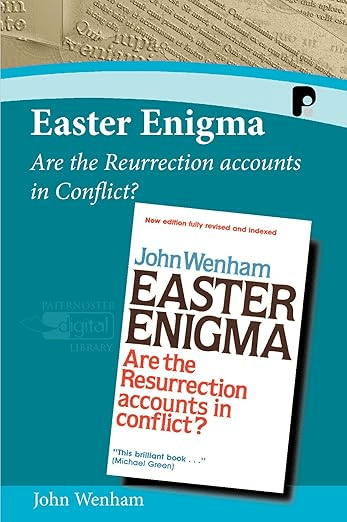
For a longer read, there is John Wenham’s slim book The Easter Enigma: Are the Resurrection Accounts in Conflict? (1986). While biblical scholars debate the precise solutions that Wenham proposes, it reveals a thoughtful account of the historical resurrection that explains the differing accounts we have in Matthew, Mark, Luke, and John. This book is available to read online with a free and simple account at Archive.org.
For a video discussing the evidence for Jesus’ resurrection, see “The Resurrection: Hoax, Heist or History?” by Peter J. Williams, Principal of Tyndale House in Cambridge, UK. The video includes a presentation that is 30 minutes long followed by 17 minutes of Q&A and a short interview of a theology student (55 minutes total).
The Resurrection: Hoax, Heist or History? – bethinking.org
Want to talk? Get in touch HERE.

 Take Another Look
Leave a comment