
Christians make a very big claim: Jesus is the most important person who has ever lived.
The claim is made not just because of his impact on world history, but because he is the hinge on which every person’s destiny ultimately turns.
That’s quite a claim.
There are accounts of Jesus’ life known as the “Gospels”. These are biographies that tell us about Jesus’ life and why it mattered. There are four of them, each named after their authors. Normally, biographies present someone as being worth understanding better or for imitation. But the Gospels do something more.
The writers of these Gospels want readers to know that Jesus is worth living and dying for. They present Jesus as the “Christ” or “Messiah”—a special and kingly figure who would enact God’s long-standing promises. His role, put briefly, involved the redemption his people, bringing peoples from all nations to God, and ultimately fixing the world to make it like it was supposed to be.
The Gospels help readers understand that Jesus is that King or Christ, and how life should be lived when Jesus is acknowledged as the Lord of all creation.
They commend Jesus to the reader, clarify reservations about his identity, and persuade us that he is the “Christ” and the way to have the blessings God has promised.
The four Gospels are known as “Matthew”, “Mark”, “Luke”, and “John”. They are about 30–40 pages long and would take around 1–2 hours to read if you sat down and read one in one go. They cover Jesus’ origins but mostly focus on the last three years of his life—presenting the things he did, the things he taught, the people he met, and the final week of his life including his arrest, trial, execution, and burial. Each Gospel is insistent that Jesus did not stay dead, but was resurrected to life again—adamant that God has vindicated him and made him King over all the world.
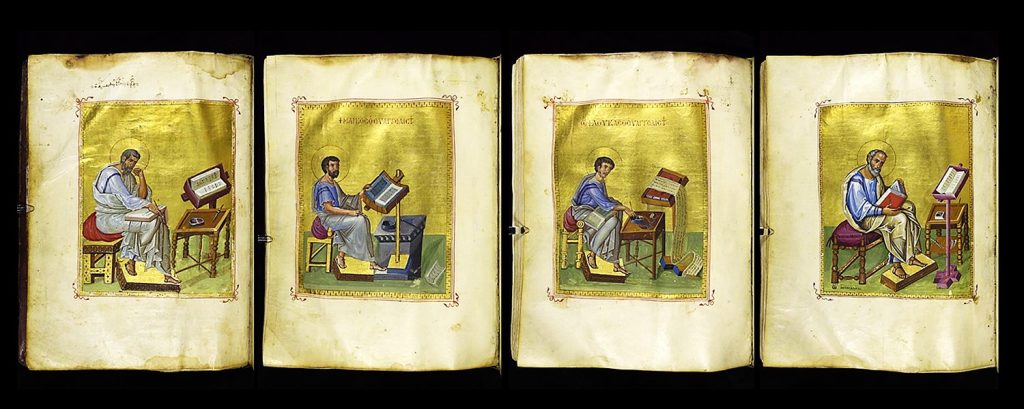
Two of the Gospels make explicit statements about why they wrote and what they want their readers to take away from it:
Luke wrote that he researched and compiled his Gospel so that the reader could “have certainty about” the things he had been taught about Jesus (Luke 1:1–4). He wanted readers to have clarity and confidence about the Jesus that Christians had been talking about.
John wrote that the events in his Gospel were written “so that you may believe that Jesus is the Christ, the Son of God, and that by believing you might have life in his name” (John 20:30–31). John’s purpose was to persuade people about Jesus’ identity (he is “the Christ” and the “Son of God”), and this with the bigger purpose of connecting people with the eternal life that Jesus has earned for his people.
Each of these biographies—these “Gospels”—is written to persuade you that Jesus is that important. They aren’t neutral. Their authors are convinced that Jesus is supremely important, and want their readers to see that too.
Will you consider reading one of the Gospels?
The Gospels of Matthew, Mark, and Luke are quite similar but each have a distinctive presentation of Jesus, while the Gospel of John is in a class all of its own. You can find these in the “New Testament” part of a printed Bible, or you can read them online through the links below.
If you have questions about what you read, do feel free to get in touch for a chat by email, phone, or in a local public location (e.g. Henderson mall food court). Contact me HERE.
To read the Gospels online, click one of the links below…
Want to read more? Read “Are the Gospels Trustworthy Histories?”
- A tenth-century portraits of the four gospel writers. Sourced from https://textandcanon.org/ ↩︎
Explore






 Take Another Look
Leave a comment